What Is Egocentric Video, and Why Robotics Labs Want It
A practical introduction to first-person footage, its uses and its limits.

Watch someone fold a towel. One hand anchors the fabric while the other finds the far edge. A corner bunches up, so they smooth it before completing the fold. It takes seconds, and most of the decisions pass without comment.
A camera across the room sees a person doing laundry. A camera worn by that person can give a much closer view of the hands, the fabric and the small adjustment that makes the fold work.
That is the appeal of egocentric video. For robotics teams, it offers a way to study physical work from close to the person doing it. Its usefulness depends on what the camera actually captures and how the recording is prepared.
What does “egocentric” mean?
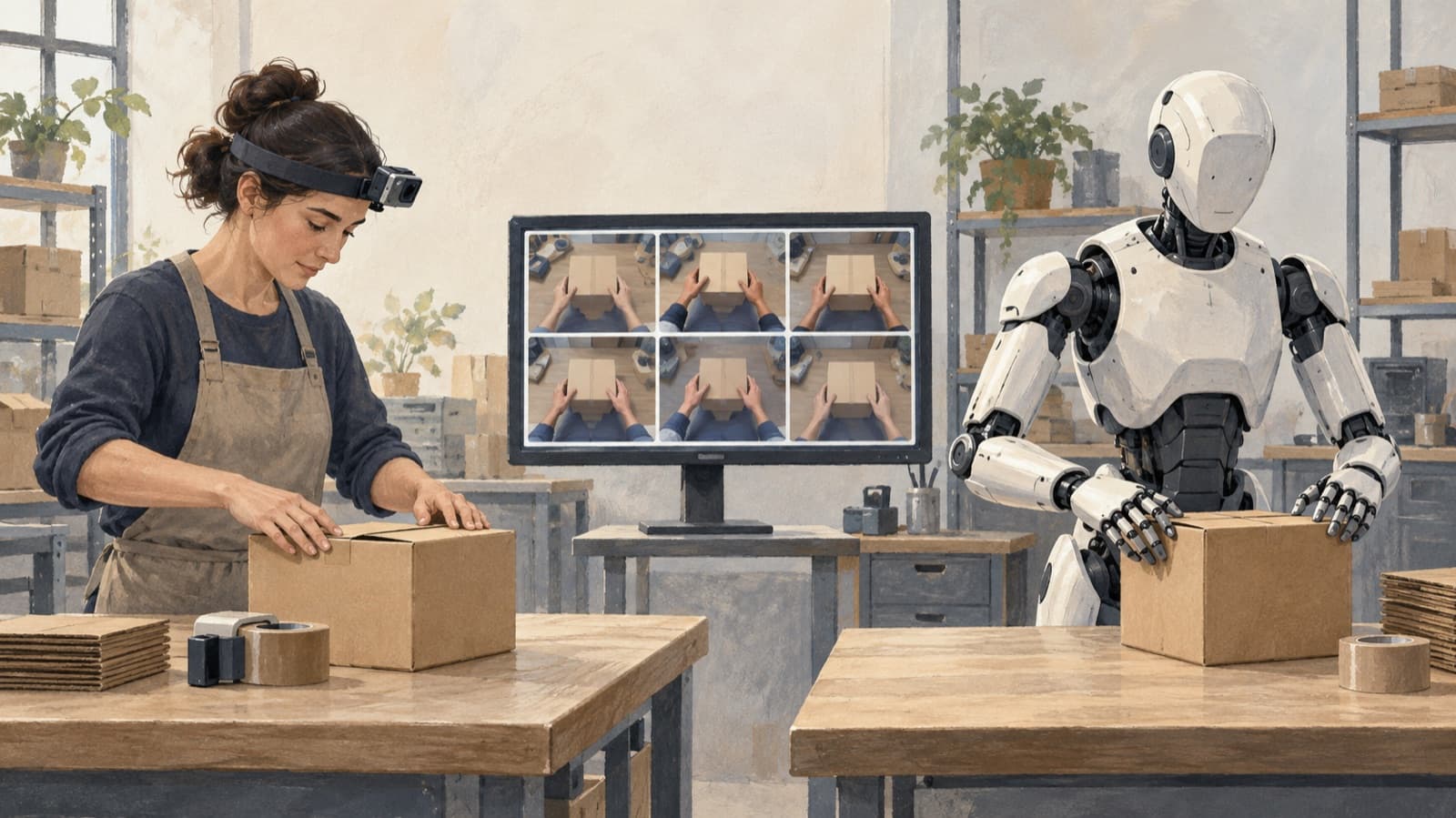
Egocentric video is footage recorded from a viewpoint attached to the person performing or experiencing an activity. You will also hear it called first-person or POV video. A head-mounted camera, camera glasses or a chest-mounted camera can produce this kind of recording.
The defining feature is the viewpoint. As the wearer turns, reaches or walks, the camera moves with them. A fixed camera watching from the room provides an external, or exocentric, view.
Those positions reveal different things. A head-mounted view may bring a small hand movement into focus. An external view may show body posture or an object hidden behind the wearer’s arm. Neither position guarantees that every important detail will be visible.
A head camera also does not automatically tell you where someone is looking. The image records the camera’s view; measuring eye gaze requires additional sensing and processing.
Why the close view matters
A useful action often happens at the meeting point of a hand and an object: fingers finding a towel edge, a wrist rotating a tool, or a thumb holding something steady. Egocentric video can make those interactions easier to inspect than a distant view.
It can also preserve the sequence around them. What was within reach before the action? Which object did the person choose? What changed afterward? For a perception system, those questions help turn an activity into something more specific than “a person is working.”
Ego4D illustrates the breadth of this research. Its benchmarks include episodic memory, hand–object interaction and forecasting. These examine questions such as what happened earlier, how an object changed and what interaction might happen next. Ego4D is a first-person perception resource; its existence does not mean the footage is already a set of robot control instructions.
How robotics teams can use it
A robotics project may use human video to study objects and actions, connect language to physical events, or explore ways of learning from human demonstrations. The recording can expose everyday variations that would be cumbersome to reproduce solely through robot sessions.
The next step depends on the learning method. A team training an action-recognition model needs different supervision from a team training a robot to move its arms. A video of a fold may show the task clearly while leaving the robot’s required movements unresolved.
EgoMimic provides a concrete research example: its system combines human egocentric demonstrations with teleoperated robot data, using alignment methods and a shared learning architecture. The reported results belong to that system and its evaluated tasks. They show a route for using human experience in robot learning, rather than a guarantee that any wearable-camera video will transfer to any robot.
For a buyer, the useful question is therefore specific: which part of your learning pipeline will use this footage, and what information does that stage require?
The viewpoint has blind spots
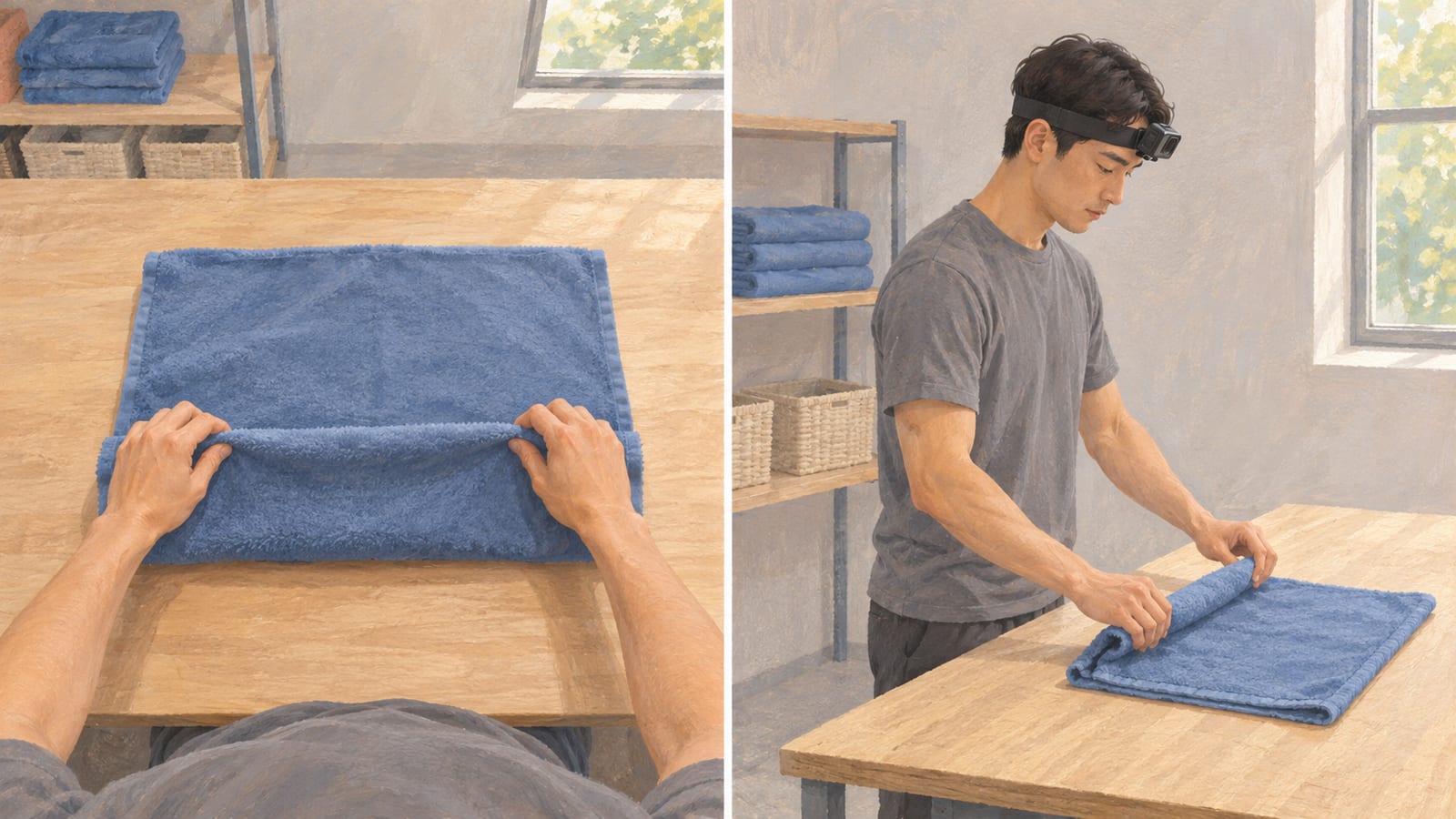
Return to the towel. If the wearer looks toward the shelf while folding, the crucial hand movement may leave the frame. If a hand covers a corner, the recording may not show whether the fabric slipped or was deliberately repositioned.
Motion blur, lighting changes and camera placement can make these problems harder to interpret. A chest camera and a head camera can produce quite different views of the same task. Test the actual setup while someone performs the actual work.
Extra views can help when the missing information matters. Ego-Exo4D records skilled activities using synchronised first-person and external cameras. It is a useful example of how viewpoints can complement one another, although a collection project should add cameras for a defined need rather than assume more cameras always improve the data.
There are also limits to what pixels measure. An ordinary RGB recording does not directly record grip force, joint positions or contact pressure. Depth, hand pose and camera motion may be measured or estimated through additional sensors and processing. Ask how each delivered signal was produced and how its quality was checked.
From a recording to a usable dataset
A folder of videos gives a lab something to watch. A well-prepared dataset gives it something it can find, interpret and use consistently.
For the towel task, annotations might mark the start and end of each fold, identify hand contact, describe an adjustment and record the visible outcome. A single label such as “folding” may be enough for one project and far too broad for another.
Definitions matter. Does the fold end when the fabric touches the table or when both hands release it? If the relevant corner is hidden, the label should preserve that uncertainty instead of inventing an answer.
Before commissioning a larger collection, agree a few practical details:
- Coverage: which tasks, objects, people and environments should appear?
- Visibility: which hands, objects and moments must stay in view?
- Signals and labels: what will be recorded, estimated or annotated, and in what format?
- Use and traceability: what permissions cover the material, and what record accompanies each clip?
Then inspect a small sample together. Check whether the important moments are visible, the labels mean the same thing to everyone and the files work in the receiving pipeline.
Start with the moment your team needs to see
Egocentric video is valuable because it can bring a model closer to the details of physical work. A useful collection starts with a clear idea of which details matter.
Guardian provides egocentric data collection and annotation, alongside remote teleoperation for robot demonstrations. Bring us a task and the moment your current data misses. We can scope the camera views, signals and annotation layers around that need.