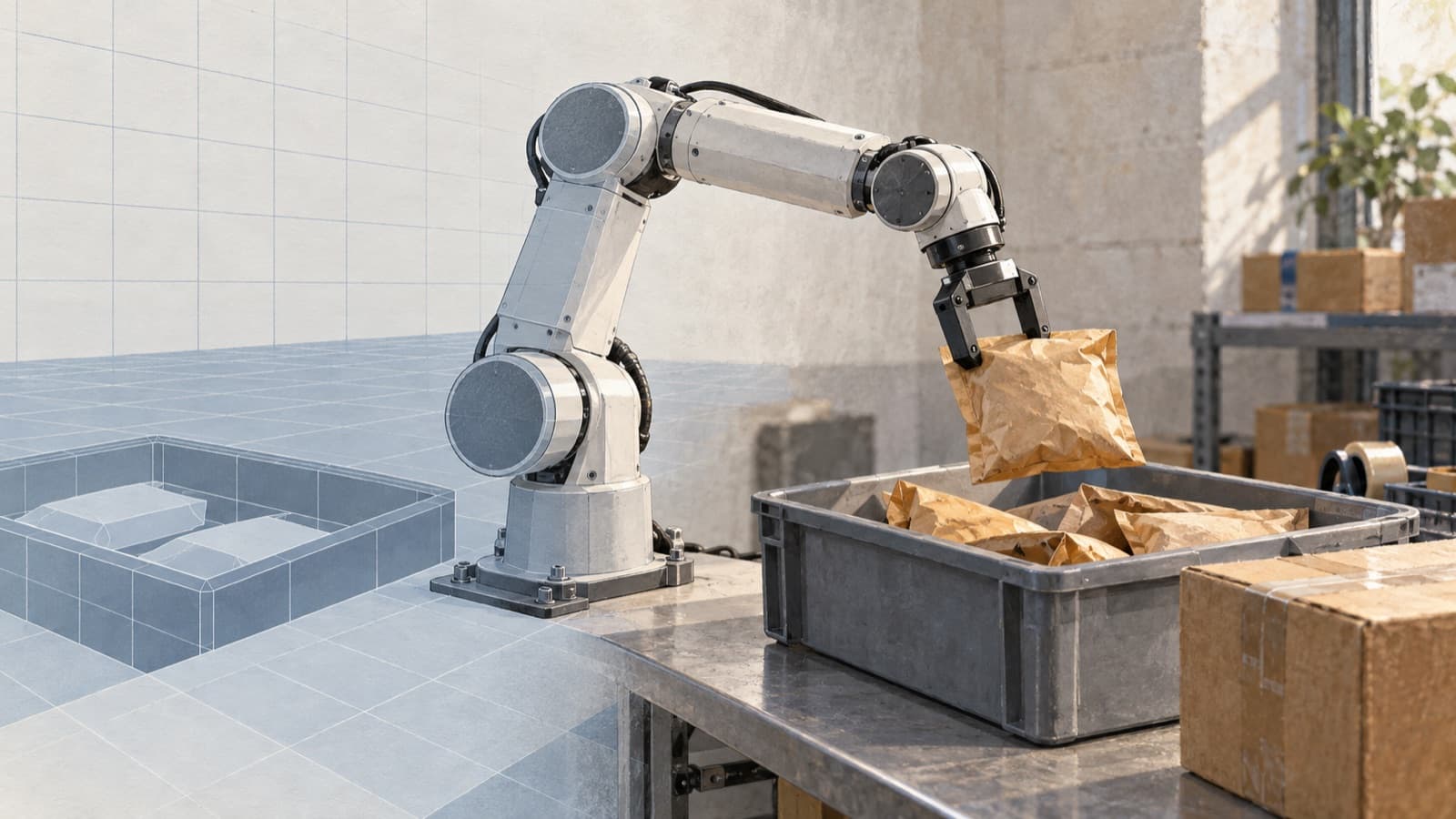
The Data Bottleneck Behind Humanoid Robots
Useful robot experience starts with a clear data brief.
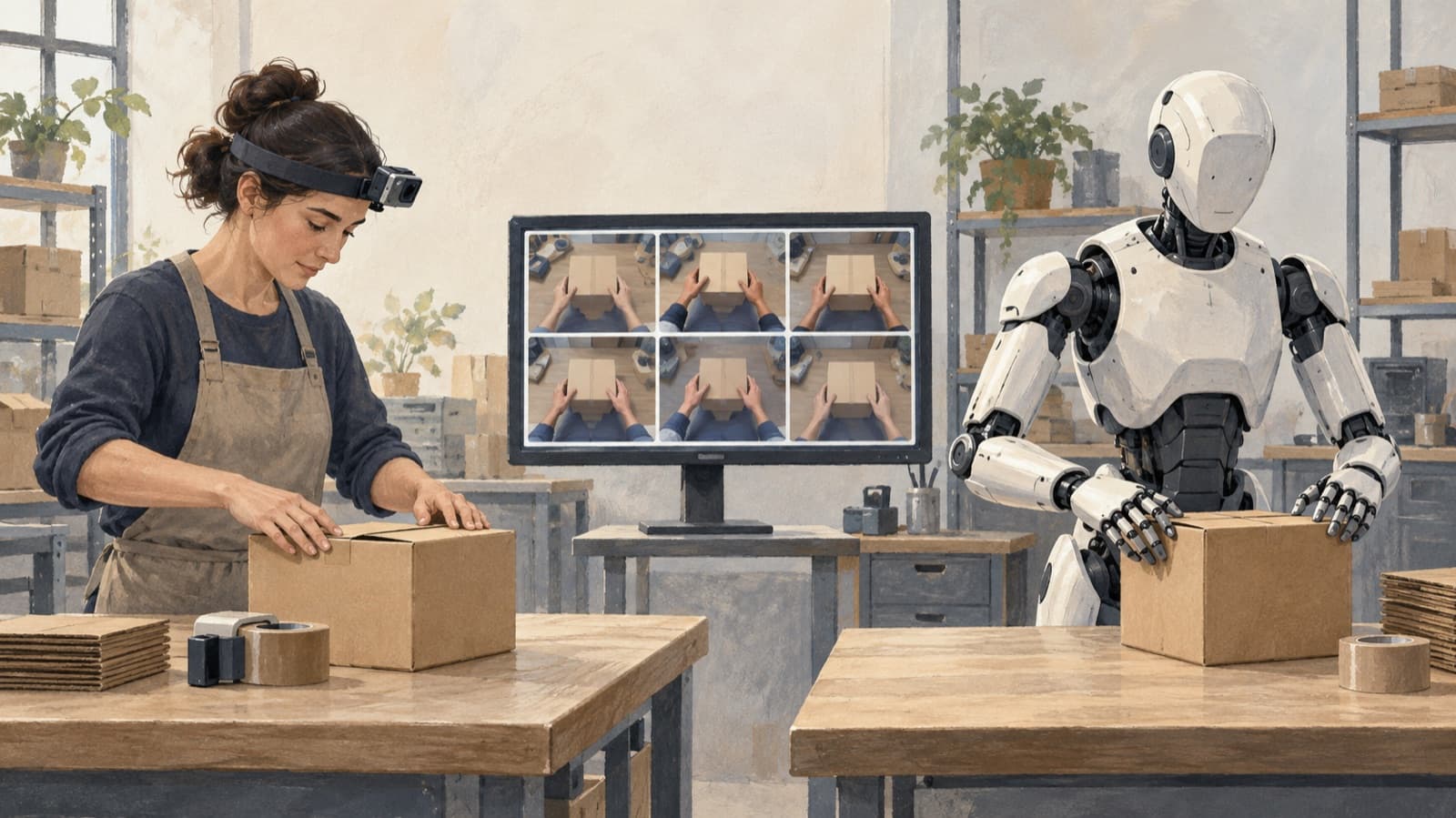
Picture a humanoid robot packing a box. In the demonstration, the carton is open, the objects are neatly arranged and every movement goes to plan. Now change one detail: a flap folds inward, or an item sits just beyond the robot’s first grasp.
That small change exposes a difficult question. What experience has the robot had of this situation, and what can it do next?
For teams building humanoids, training data is part of that answer. Hardware, control and model design all matter. But a capable body also needs useful experience: examples that connect what it sees, the actions available to it and the results of those actions.
A robot needs more than a view of the task
A human watching a packing video can fill in a great deal. We know how cardboard bends, when to loosen our grip and how to steady something with the other hand. A recording may leave much of that knowledge unstated.
For robot learning, the required evidence depends on the method. Video can show the task and its visual sequence. Robot demonstrations can also pair observations with recorded actions and state, such as gripper movement or joint positions. Neither source automatically supplies every signal a project needs.
That distinction matters when buying humanoid robot training data. “Hours of footage” describes volume. It does not tell the team whether the right action, viewpoint, timing or outcome is available.
Similar bodies still have different constraints
A humanoid’s familiar outline does not make human movement directly interchangeable with robot commands. Reach, joint limits, hand design, sensing and actuation can differ. A useful human demonstration still needs a way to connect to the target robot’s capabilities.
Stanford’s research with the H1 humanoid describes a system that combines learning in simulation, following human motion and collecting whole-body robot demonstrations through teleoperation. It is a concrete example of the work involved in connecting human experience to robot skills.
For a collection brief, the implication is practical: decide which parts of the behaviour must be observed and which must be measured on the robot. If the task involves moving a box while changing stance, a close-up of the hands may leave important context outside the frame.
The missing experience may be variety
Repeating one successful task can help establish a baseline. It can also leave the dataset concentrated around a narrow version of the world.
Think about the same packing job across different carton sizes, shelf heights, object positions and lighting conditions. Add a second person with a different way of approaching it. The task name stays the same, while the observations and movements change.
The DROID project collected robot manipulation demonstrations across 564 scenes and 86 tasks, and reports improved robustness in its evaluated settings. DROID uses a robot-arm platform rather than a humanoid. Its relevance here is the collection problem: experience has to cover meaningful variation, and gathering that variation takes deliberate organisation.
A sensible brief names the variations the team wants to test. That gives collectors a clearer job than simply recording until the hour target is met.
Human video and robot demonstrations bring different evidence
Egocentric video puts the camera near the person doing the work. It can help capture how hands approach an object, how a task unfolds and what happens when the first attempt needs adjusting.
Teleoperation records a different kind of experience: a person directs the robot, and the collection system can capture the resulting observations and robot-side signals. The exact channels still need to be specified and checked.
There is evidence that sharing robot experience can help. Open X-Embodiment brings together datasets from multiple robot embodiments in standardised formats and demonstrates positive transfer in its experiments. That supports the value of pooling useful experience, while leaving the target team responsible for validating performance on its own robot and tasks.
Simulation can contribute additional practice and controlled variation. The collection decision is which uncertainty each source will help resolve, and how the combined data will be evaluated.
Keep the adjustment, not just the successful ending
Suppose a person lifts an object, feels it shift, changes grip and then places it safely. If the recording begins after the adjustment, the dataset loses the part that explains how the person recovered.
Recovery examples need careful handling. Keep the surrounding context, identify the outcome and distinguish a completed task from an abandoned attempt. Where something cannot be determined from the footage, record that uncertainty.
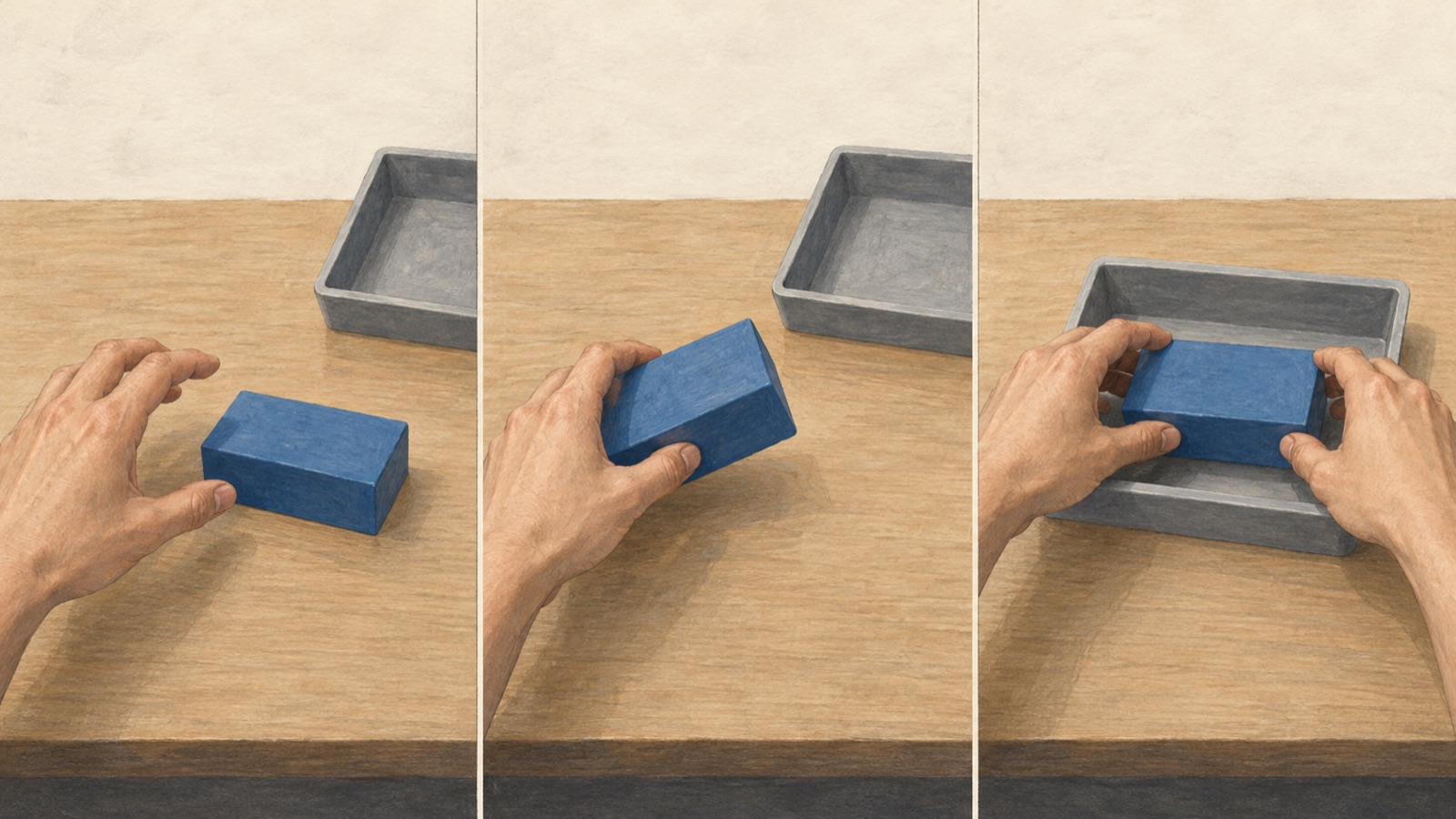
A failure clip is not automatically useful, and a successful clip is not automatically complete. The question is whether the episode contains evidence relevant to the learning objective. That makes outcome definitions and review rules part of collection planning.
Turn the data brief into an acceptance test
Before scaling, run a small batch through the whole route: capture, review, annotation, export and ingestion by the receiving team.
Agree a few concrete checks:
- Task coverage: Which actions, environments and variations must the batch include?
- Required signals: Are the views, robot channels, timestamps and relevant calibration records present?
- Label quality: Are action boundaries, contact events and outcomes defined clearly enough for consistent review?
- Delivery quality: Can the receiving pipeline open the files and trace every label to the correct recording version?
Measure usable output as well as recorded time. A long session with the key interaction hidden may contribute less to the brief than a short, complete episode. Keep evaluation examples separate from training examples so the team can assess what the model learned without simply testing on familiar recordings.
Collect the next useful experience
The data bottleneck becomes easier to act on when it is expressed as a specific gap: a missing view, an underrepresented task variation, an unrecorded robot signal or a recovery the current model cannot handle.
Start there. Collect a focused batch, inspect it and test whether it addresses the gap before committing to more volume.
Guardian provides egocentric data gathering, teleoperation and annotation. Bring the tasks, target robot and intended learning use to the scoping conversation, so the capture plan and acceptance checks can be built around the experience your team needs.